
“How much for a website?” is usually the first question founders ask, and it’s the hardest one to answer in one line. Some businesses in India pay ₹12,000 for a site that does the job perfectly. Others pay ₹4 lakh for one that never brings in a single enquiry.
So instead of a vague “it depends”, this guide breaks down what a website really costs in India in 2026, what you get at each price point, and the yearly costs that tend to show up after launch. If you’re comparing quotes right now, it should help you spot which ones are fair and which ones are padded.
Quick answer: website cost in India in 2026
Here are typical ranges across Indian freelancers, small studios and agencies. They’re starting points. Your number moves up or down with the scope.
| Type of website | Typical cost in India (2026) | Typical timeline |
|---|---|---|
| Basic business website (5–8 pages) | ₹15,000 – ₹60,000 | 1–3 weeks |
| Custom-designed business website | ₹60,000 – ₹2,50,000 | 3–6 weeks |
| WordPress website with blog and CMS | ₹40,000 – ₹1,50,000 | 2–5 weeks |
| E-commerce store (Shopify / WooCommerce) | ₹60,000 – ₹4,00,000 | 4–10 weeks |
| Custom web app or portal | ₹3,00,000 – ₹15,00,000+ | 2–6 months |
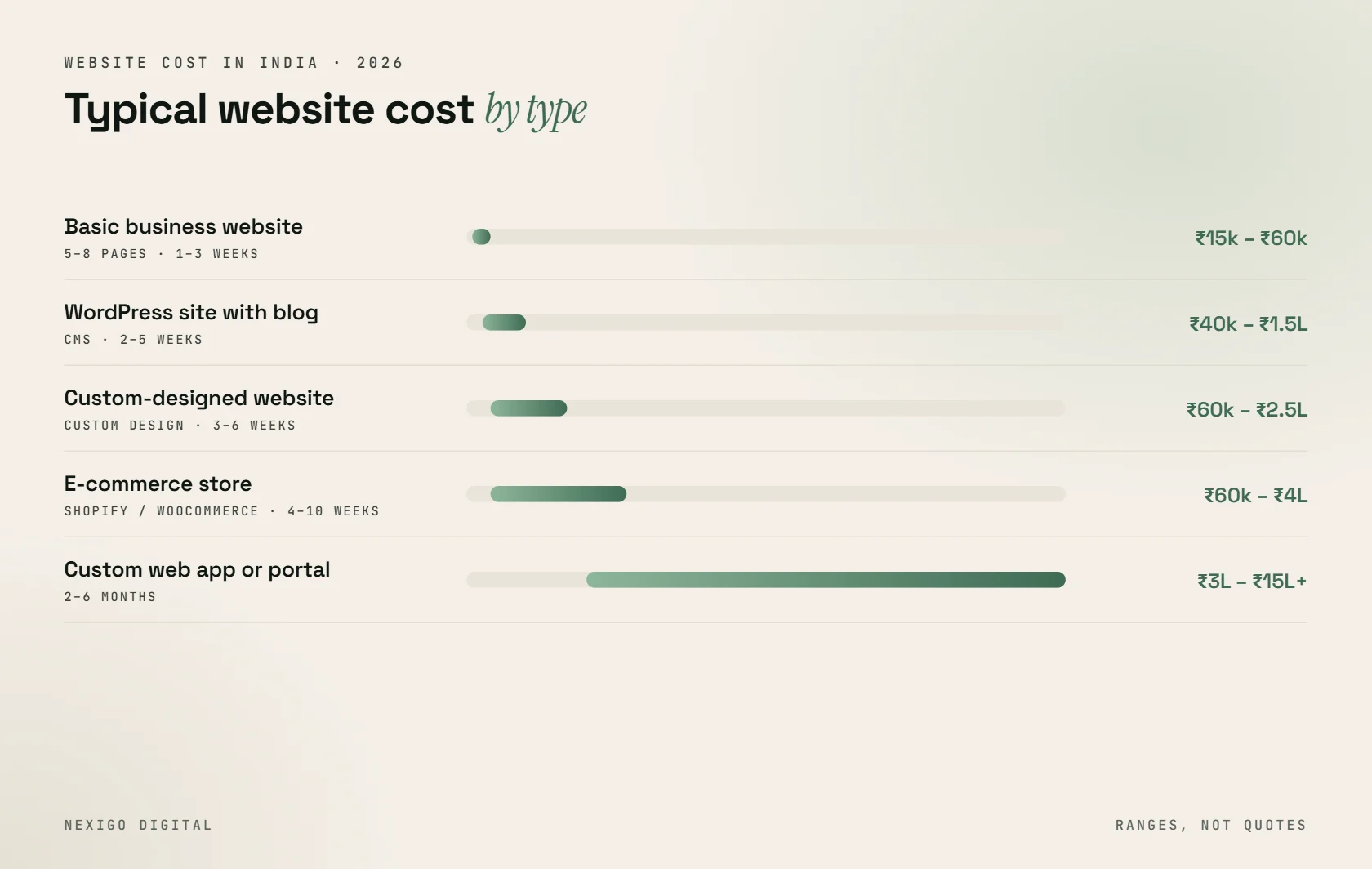
The gap between the low and high end of each row is mostly about three things: whether the design is custom or template-based, how much content and functionality you need, and who is building it.
What actually drives the price of a website
Two quotes for “a 10-page website” can be ₹20,000 apart and both be honest. The difference usually sits in these factors.
1. Template design vs custom design
A good template is a perfectly reasonable choice for a new business. You pick a theme, swap in your logo, colours and content, and launch fast. It’s cheap because most of the design work was done once and sold many times.
Custom design means a designer works out your page structure, wireframes and visual style in a tool like Figma before anyone writes code. It costs more because it is real hours of thinking about your customers, but it is also how you end up with a site that looks like your brand instead of one that looks like 3,000 other sites using the same theme.
Our honest take: if you’re validating an idea, start with a template. If your website is your main sales channel, or you sell to premium clients, custom design usually pays for itself.
2. Number of pages and how complex they are
A “page” isn’t a fixed unit of work. A simple About page might take two hours. A service page with pricing tables, FAQs and a lead form might take two days once you count copy, design and testing.
When you compare quotes, ask each agency to list the pages and what goes on each one. You’ll quickly see who is quoting for the same thing.
3. Features and integrations
This is where budgets quietly double. Each of these adds real development and testing time:
- Online payments (Razorpay, PayU, Stripe)
- Booking or appointment systems
- Multi-language pages
- Member logins and dashboards
- CRM integration (HubSpot, Zoho, Salesforce)
- WhatsApp chat, lead routing and automation
- Custom calculators or quote builders
None of these are bad ideas. Just add them because they help you sell, not because a competitor has them.
4. Content: copy, photos and video
Many quotes assume you’ll send the text and images. Then the project stalls for three weeks because nobody has written the About page.
Professional copywriting typically adds ₹1,500–₹5,000 per page in India, and a half-day product or team photoshoot can add ₹15,000–₹50,000 in most cities. It sounds like a lot until you compare it with a beautiful website full of stock photos and text that doesn’t explain what you do.
5. Who builds it: freelancer, small studio or agency
| Who builds it | Typical price | Good for | Watch out for |
|---|---|---|---|
| Freelancer | Lowest | Simple sites, tight budgets | Availability, no backup if they disappear |
| Small studio | Mid | Most small and mid businesses | Limited capacity for big builds |
| Full-service agency | Highest | Brand-led sites, e-commerce, ongoing growth | Paying for layers you don’t need |
There’s no single right answer. A great freelancer beats a lazy agency every time. What matters is that whoever you hire can show similar work and explain how they’ll handle speed, SEO basics and support after launch.
The hidden yearly costs of owning a website
The build fee is a one-time cost. Running the website is not. These are the line items that surprise people in year two.
| Yearly cost | Typical range in India |
|---|---|
| Domain name (.com or .in) | ₹800 – ₹1,800 per year |
| Hosting (shared to managed cloud) | ₹3,000 – ₹30,000 per year |
| Premium theme or plugin licences | ₹3,000 – ₹20,000 per year |
| SSL certificate | Usually free with good hosting |
| Business email (Google Workspace / Zoho) | ₹1,500 – ₹2,500 per user per year |
| Maintenance, updates and backups | ₹15,000 – ₹1,00,000 per year |
| Shopify plan (if you use Shopify) | Roughly ₹2,400 – ₹3,300 per month for Basic, depending on billing |
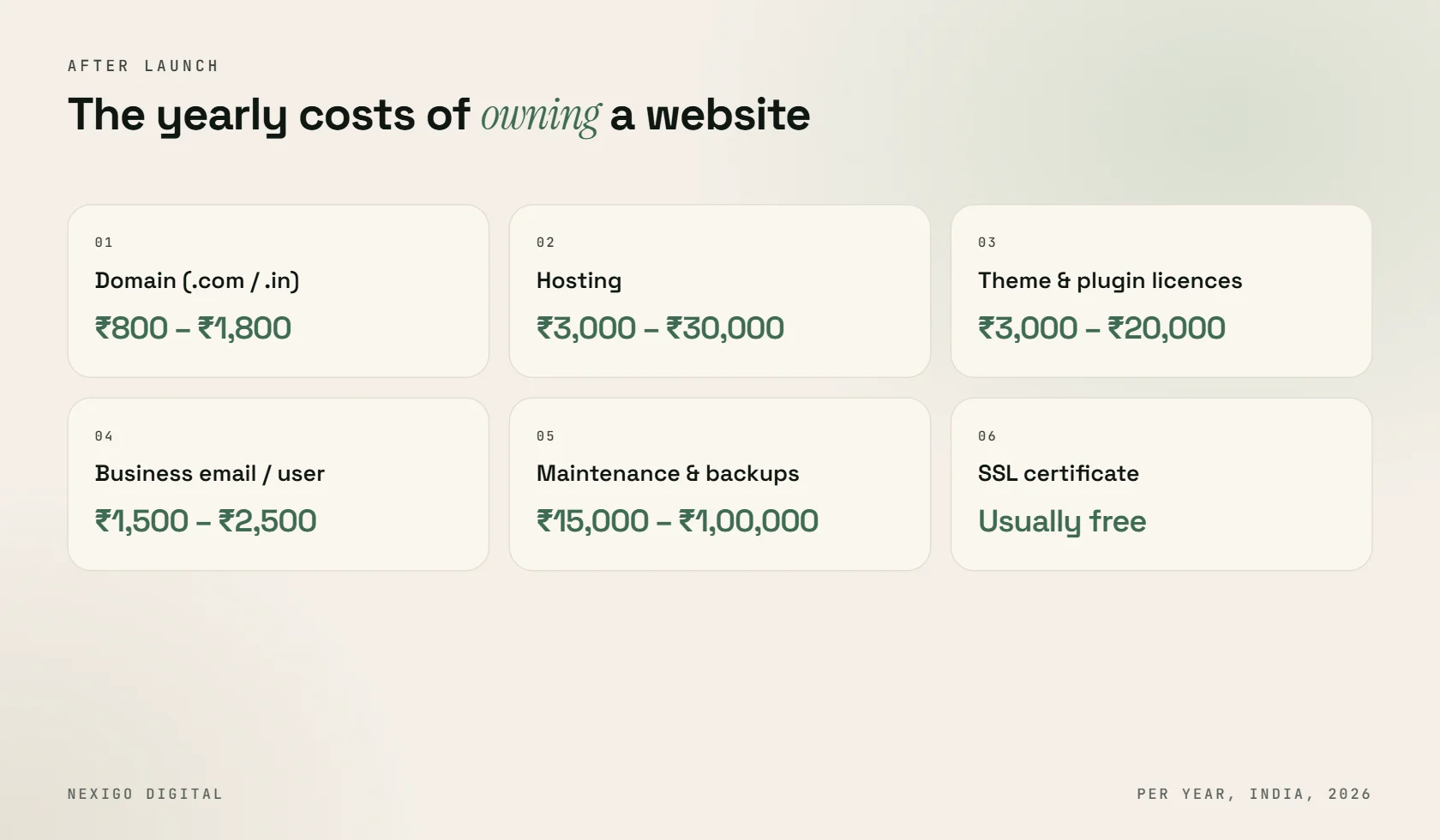
A cheap build on bad hosting with no maintenance plan often costs more in the long run. Sites get hacked, break after a plugin update, or take eight seconds to load on mobile. Fixing that later is almost always more expensive than doing it properly the first time.
Cost by type of website (with examples)
Basic business website: ₹15,000 – ₹60,000
Right for a local service business, consultant, clinic or a new startup that needs to look credible. You get five to eight pages, a contact form, WhatsApp button, Google Maps, basic on-page SEO and mobile-friendly design, usually on WordPress with a quality theme.
What you usually don’t get at this price: custom design, copywriting, advanced SEO or integrations.
Custom business website: ₹60,000 – ₹2,50,000
This is where most growing companies land. The designer creates your layouts from scratch, the copy is written around your services, and the site is built for speed and conversions from day one. Expect a discovery call, wireframes, two rounds of design revisions, development, testing, and training so your team can edit content.
If you want to see what goes into a project like this, our website design and development service page walks through the full scope.
E-commerce website: ₹60,000 – ₹4,00,000
An online store is more than pages. You’re paying for product catalogue setup, filters, payment gateways, shipping and tax rules, order emails, inventory, and a checkout that people actually finish.
The platform decision matters a lot here. If you’re torn, read our guide on WordPress vs Shopify, which compares costs, fees and flexibility for Indian stores.
Custom web application: ₹3,00,000 and up
Portals, SaaS products, booking platforms, internal dashboards. These are software projects, so they’re priced on engineering time, not pages. A sensible approach is to build a small first version (an MVP) for real users, then expand once you know what they use.
Example budgets for three common businesses
Numbers make more sense with a real business in mind. These are example budgets, not quotes, but they show how the pieces add up.
A dental clinic in a tier-2 city. Six pages (home, about, treatments, doctors, gallery, contact), online appointment requests, WhatsApp button, Google Maps and local SEO basics. A clean custom design on WordPress lands around ₹50,000–₹90,000, plus about ₹8,000–₹15,000 a year for domain, hosting and maintenance. The clinic writes its own treatment descriptions to save money, and pays a photographer for half a day.
A D2C skincare brand launching online. 40 products, Razorpay checkout, shipping integration, reviews, and a brand-led design that doesn’t look like a template. On Shopify, expect ₹1,20,000–₹2,50,000 for the build, then the monthly Shopify plan, payment gateway fees and a few paid apps. Product photography is often the biggest extra cost, and the one that matters most for sales.
A B2B manufacturer. Product catalogue with 60 items, downloadable spec sheets, enquiry forms that go straight to the sales team’s CRM, and pages in English and Hindi. Usually ₹1,50,000–₹3,00,000, mostly because of the catalogue structure, multilingual setup and CRM integration rather than the design itself.
In all three, the cost is driven by what the website has to do, not how many pages it has.
How to get an accurate quote (and avoid overpaying)
You’ll get far better quotes, and fewer surprises, if you send agencies a short brief. It doesn’t need to be formal. One page covering these points is enough:
- What your business does and who your customers are
- The main goal of the website (leads, sales, bookings, credibility)
- The pages you think you need
- Features you need on day one, and ones that can wait
- Three websites you like, and what you like about them
- Who will provide the text and photos
- Your rough budget and launch date
Sharing a budget feels risky, but it saves everyone time. A good agency will tell you what’s realistic for that amount instead of quoting the moon.
Red flags in website quotes
- No breakdown, just one number
- No mention of mobile speed or basic SEO
- The agency keeps your hosting, domain or admin logins in their name
- “Unlimited revisions” (it usually means unclear scope)
- No plan for what happens after launch
Your domain, hosting account and website files should always belong to you. If an agency hesitates on that, walk away.
Is a cheap website ever the right choice?
Yes, sometimes. If you’re testing a new idea, running a small local business that gets most customers through referrals, or you simply need something live next week, a clean ₹15,000–₹25,000 website is fine. Better to launch something simple than wait six months for something perfect.
Where cheap goes wrong is when the website is supposed to be your main source of customers. A slow, generic site with no SEO structure won’t rank and won’t convert, and you’ll end up paying for a rebuild within a year or two.
Our take
Price the website against what it needs to do. If a new website brings in even two or three extra clients a month, a ₹1–2 lakh build pays for itself quickly. If it’s a digital business card, don’t spend like it’s a sales engine.
If you’d like a straight answer for your project, tell us what you’re planning. We’ll send a written scope, timeline and fixed price within 48 hours of a short call, and you can compare it against anyone else’s quote.
Frequently asked questions
How much does a basic website cost in India?
A basic 5–8 page business website in India typically costs ₹15,000 to ₹60,000 in 2026, depending on design quality, who builds it and whether content is included.
What is the cost of an e-commerce website in India?
Most e-commerce websites in India cost between ₹60,000 and ₹4,00,000. The price depends on the platform, number of products, custom design, and integrations such as payment gateways, shipping and inventory.
Why do website quotes vary so much?
Quotes differ because of custom vs template design, number and complexity of pages, features and integrations, whether copywriting and photos are included, and who is building the site.
What are the yearly costs of running a website?
Expect to pay for the domain (about ₹800–₹1,800 a year), hosting (₹3,000–₹30,000 a year), plugin or theme licences, business email, and maintenance. Shopify stores also pay a monthly plan fee.
How long does it take to build a website?
A basic website takes 1–3 weeks, a custom business website 3–6 weeks, and an e-commerce store 4–10 weeks. Delays usually come from missing content rather than development.
Need help with this?
Get a website that brings enquiries, not just visitors.
Send me your current website or idea on WhatsApp. I'll reply personally with honest advice and a clear quote.

Written by
Sourabh Kumar Pandit
I have been building websites and running SEO and ad campaigns for Indian businesses since 2019, with 200+ projects for 180+ clients from Delhi and Patna. I write these guides from what actually works on real client projects.