
Why most small business websites don’t bring customers
A good website for a small business in India does one job: it turns a stranger on Google into a call or a WhatsApp message. Looks matter, but they come second.
I’ve been building websites since 2019, and I’ve seen this pattern more times than I can count. A shop owner pays for a site, it looks nice on the designer’s laptop, and then nothing happens. No calls. No enquiries. After a few months the site is forgotten, and the owner decides websites “don’t work” for businesses like theirs.
They do work. The site just wasn’t built for the way Indian customers actually search and decide. Below are the 9 things I check on every site before it goes live. If your current website misses three or more of them, it is probably costing you customers.
1. Design it for the phone first
Most of your visitors will open your site on a phone, often on a slow connection, sometimes standing in a market. So I design the mobile version first and the desktop version second, not the other way round.
Open your own website on your phone right now. Can you read the text without zooming? Can you tap the buttons with your thumb? If you have to pinch and scroll sideways, your customers are leaving.
2. Make it load fast
A slow site loses people before they see anything. Big uncompressed photos, too many plugins and heavy sliders are the usual reasons. Here is what I do on every project:
- Compress every image and use WebP format
- Keep plugins to the ones the site actually needs
- Skip auto-playing sliders on the home page
- Use good hosting, because cheap shared hosting slows everything down
You can test your own site free on Google PageSpeed Insights. Check the mobile score, not just desktop.
3. Say what you do in the first screen
When someone lands on your home page, they should know three things within a few seconds: what you sell, where you are, and how to contact you. “Welcome to our website” tells them nothing.
Compare these two headlines:
- “Welcome to Sharma Enterprises”
- “AC repair and service in Patna, same-day visit”
The second one is a little less elegant. It also gets far more calls, because the visitor knows straight away they are in the right place.
4. Put WhatsApp and call buttons where thumbs can reach
In India, a lot of customers would rather send a WhatsApp message than fill a contact form. Some would rather call. Give them both, and make it easy.
- A WhatsApp button that opens a chat with a ready message, like “Hi, I saw your website and want to know about…”
- A tap-to-call button on mobile
- Both visible on every page, not hidden at the bottom of the contact page
This one change alone often does more for enquiries than a full redesign.
5. Show people you are real
Before anyone pays a business they found online, they want proof that it exists and that others trust it. Trust signals do that work for you:
- Your full address and a Google Map
- Real photos of your shop, team or work
- Google reviews from actual customers
- Your GST number or registration, if you have one
- How long you’ve been in business
Stock photos of smiling people in suits do the opposite. Customers can spot them instantly.
6. Build in local SEO from day one
If your customers come from your city, your website has to tell Google which city that is. That means your city and area in the page titles, your address written the same way everywhere, and a page for each service you offer.
Link the site to your Google Business Profile too. When someone searches “bakery near me” or “CA in Delhi”, Google shows the Map results first. A website that matches your profile helps you get into that list.
7. Keep the menu short and obvious
A small business site rarely needs more than five or six menu items. Home, About, Services, Work or Gallery, Reviews, Contact. That’s usually enough.
If a visitor has to think about where to click, the menu is too clever. Use the words your customers use. “Our Offerings” sounds nice in a meeting. “Services” is what people actually look for.
8. Write real content in plain words
Google can’t rank a page that says almost nothing, and customers can’t trust it either. Each service page should answer the questions people ask you on the phone:
- What exactly do you do, and for whom?
- How long does it take?
- What does it roughly cost, or what does the price depend on?
- Which areas do you serve?
Write it the way you’d explain it across the counter. Short sentences. No jargon. If your customers are more comfortable in Hindi, a Hindi or Hinglish section can help a lot.
9. Make sure you own it and can update it
This is the point most people only think about when it’s too late. Before you hire anyone, make sure:
- The domain is registered in your name, with your email
- You get the admin login for the website and the hosting
- You can change prices, photos and timings yourself, without calling the designer every time
I build most small business sites on WordPress for exactly this reason. You stay in control, and you’re never stuck if your designer moves on.
Mistakes to avoid when you hire a web designer
I’ll be honest, some of these I learned by watching clients come to me after a bad first experience.
- Choosing only on price. A very cheap site often means a copied template, no mobile testing and no support. You end up paying twice.
- No written scope. Agree in writing on the number of pages, revisions, delivery date and what happens after launch.
- Forgetting the yearly costs. Domain renewal, hosting and maintenance come every year. Ask for them upfront so there are no surprises.
- Not asking for past work. Open two or three sites they’ve built, on your phone, and check them against the list above.
- No plan after launch. A website needs small updates and backups. Ask who will do that, and for how long, before you pay.
Frequently asked questions
How many pages does a small business website need?
Most need five to eight: Home, About, one page per main service, a gallery or past work page, reviews and Contact. Add more only when you have something useful to say on them.
How long does it take to build a small business website?
A simple business site usually takes two to four weeks. Most of that time goes into collecting your content, photos and feedback, not the design itself.
Is WordPress good for a small business website in India?
Yes, for most businesses. It’s affordable, easy to update yourself, works well for SEO, and almost every developer in India knows it, so you’re never stuck with one person.
Do I need a website if I already have an Instagram page?
Instagram is great for showing your work, but you don’t own it and Google rarely shows it for searches like “tailor near me”. A website plus a Google Business Profile is what gets you found by people who are ready to buy.
How much does website design cost in India?
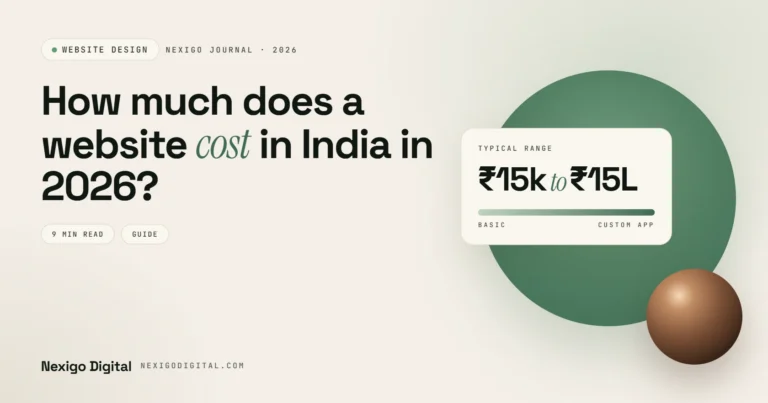
It depends on the number of pages, features and who builds it. I’ve written a full price guide here: How Much Does a Website Cost in India in 2026?
Want a second opinion on your website?
You don’t need a fancy website. You need one that loads fast on a phone, tells people clearly what you do, and makes it easy for them to call or message you. Get those basics right and the design can be simple.
If you’d like me to look at your current site, send me the link on WhatsApp or through the contact page. I’ll tell you honestly which of these 9 points it misses, even if you don’t end up hiring me. You can also see the kind of sites I build on my portfolio or check my website design services.
Sourabh Kumar Pandit, Nexigo Digital. Building websites for Indian businesses since 2019, from Delhi and Patna.
#Local SEO #Small Business #Website Design India
Need help with this?
Get a website that brings enquiries, not just visitors.
Send me your current website or idea on WhatsApp. I'll reply personally with honest advice and a clear quote.

Written by
Sourabh Kumar Pandit
Founder, Nexigo Digital · Web Designer & Digital Marketer
I have been building websites and running SEO and ad campaigns for Indian businesses since 2019, with 200+ projects for 180+ clients from Delhi and Patna. I write these guides from what actually works on real client projects.