“Should we run Facebook ads or Google ads?” It’s one of the most common questions business owners ask, often after they’ve already tried one, spent ₹30,000, and still aren’t sure whether it worked.
The honest answer is that they do different jobs. Comparing them directly is a bit like asking whether you need a shop window or a salesperson. Both sell. They just reach people at different moments.
This guide explains how Meta Ads (Facebook and Instagram) and Google Ads actually work, where each one shines, what they tend to cost, and how to decide where your first rupee should go.
The one difference that explains everything
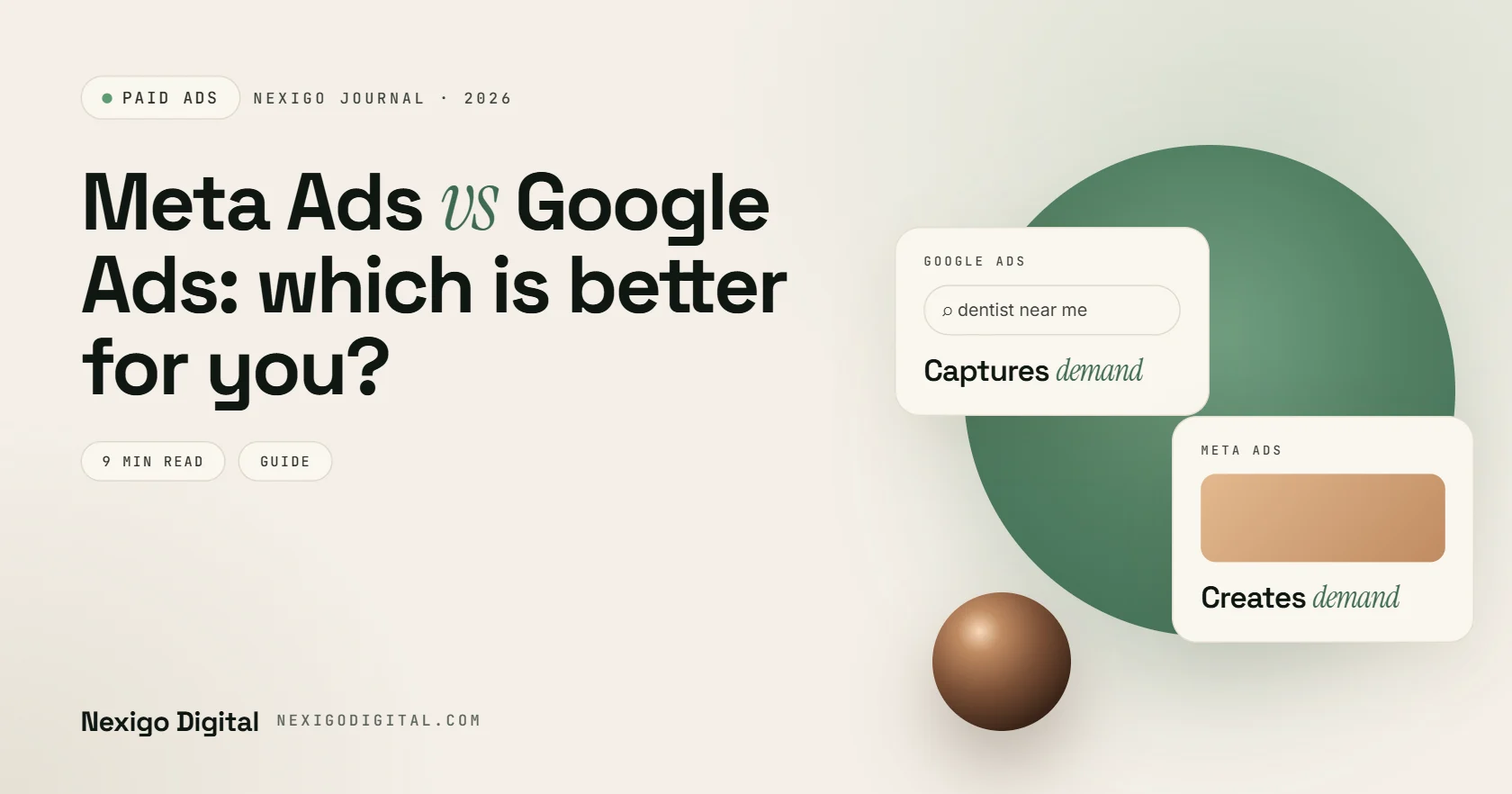
Google Ads captures demand. Someone types “dentist near me” or “buy running shoes size 9” and you show up. The person already knows what they want. Your job is to be the best answer.
Meta Ads creates demand. Someone is scrolling Instagram, not looking for anything, and your ad stops them. They didn’t know your product existed five seconds ago. Your job is to make them want it.
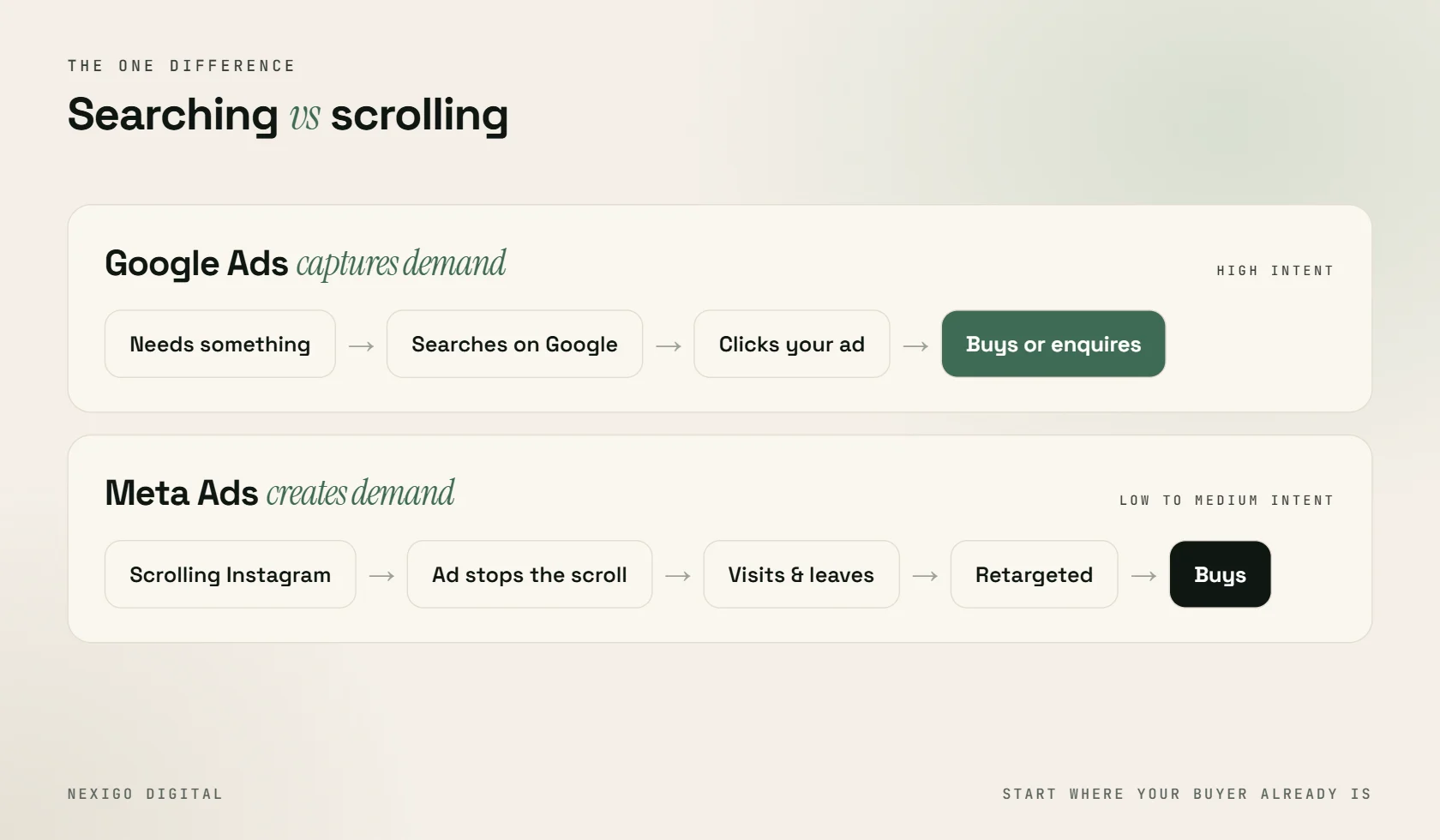
Almost every other difference between the two platforms comes from this. Intent, targeting, creative, cost per click, conversion rates: all of it follows from whether the person was searching or scrolling.
How Google Ads works
Google Ads shows your ads when people search on Google, and across YouTube, Gmail, Maps and partner sites. For most businesses starting out, Search campaigns are the main event.
You choose keywords that match what customers search for. When someone searches, Google runs an auction based on your bid and how relevant and useful your ad and landing page are. You pay when someone clicks.
Other Google campaign types worth knowing:
- Performance Max runs across all Google channels from one campaign, using automation. Powerful for e-commerce with a product feed, but you get less control and less insight.
- Shopping shows your products with image and price at the top of search results. Essential for most online stores.
- YouTube and Demand Gen work more like social ads, reaching people by interest rather than search.
Where Google Ads works best
- Services people search for when they need them: plumbers, clinics, lawyers, repair shops, coaching institutes
- B2B services with clear search terms (“payroll software for small business”)
- E-commerce products people search for by name or type
- Urgent needs where people want an answer today
How Meta Ads works
Meta Ads run across Facebook, Instagram, Messenger, WhatsApp-linked campaigns and the Audience Network. You don’t target keywords. You target people based on location, age, interests and behaviour, or increasingly, you give Meta’s algorithm broad targeting and let it find buyers based on your conversion data.
The creative does most of the work. A scroll-stopping video or image matters more on Meta than almost anything else you control.
A few things matter a lot on Meta in 2026:
- Conversions API (CAPI). With browser tracking getting weaker, sending conversion events from your server or store platform gives Meta the data it needs to optimise. Without it, results often look worse than they really are.
- Advantage+ campaigns. Meta’s automated campaigns (especially Advantage+ shopping) often beat manually targeted ones for e-commerce, as long as tracking is solid.
- Creative testing. Fresh creative every week or two keeps results from fading as audiences get tired of the same ads.
Where Meta Ads works best
- Visual products: fashion, beauty, home decor, food, fitness
- Impulse or lifestyle purchases under a few thousand rupees
- New products people don’t know to search for yet
- Local businesses promoting offers, events or openings
- Building retargeting audiences that you convert later
Cost: which is cheaper?
Meta clicks are usually cheaper than Google search clicks. That doesn’t automatically make Meta cheaper per customer.
On Google, you pay more per click because the person is already looking for what you sell, so a bigger share of them buy or enquire. On Meta, you pay less per click, but more people are just curious, so a smaller share convert, at least on the first visit.
What matters is cost per lead or cost per sale, not cost per click. It’s common for Google leads to cost more than Meta leads and still close at a much higher rate. It’s just as common for a D2C brand to get cheaper sales from Meta than from Google Shopping. You only find out which applies to you by testing with proper tracking.
A few practical notes for Indian businesses:
- Highly competitive search categories (real estate, education, finance, insurance) can have very expensive clicks on Google.
- Meta’s algorithm needs data. Meta recommends around 50 optimisation events per ad set within a week to get out of the learning phase. If your budget can’t get close to that, optimise for an earlier step (like add-to-cart or leads) or consolidate ad sets.
- Ad spend is paid to Meta or Google directly. Your agency’s management fee is separate.
Side-by-side comparison
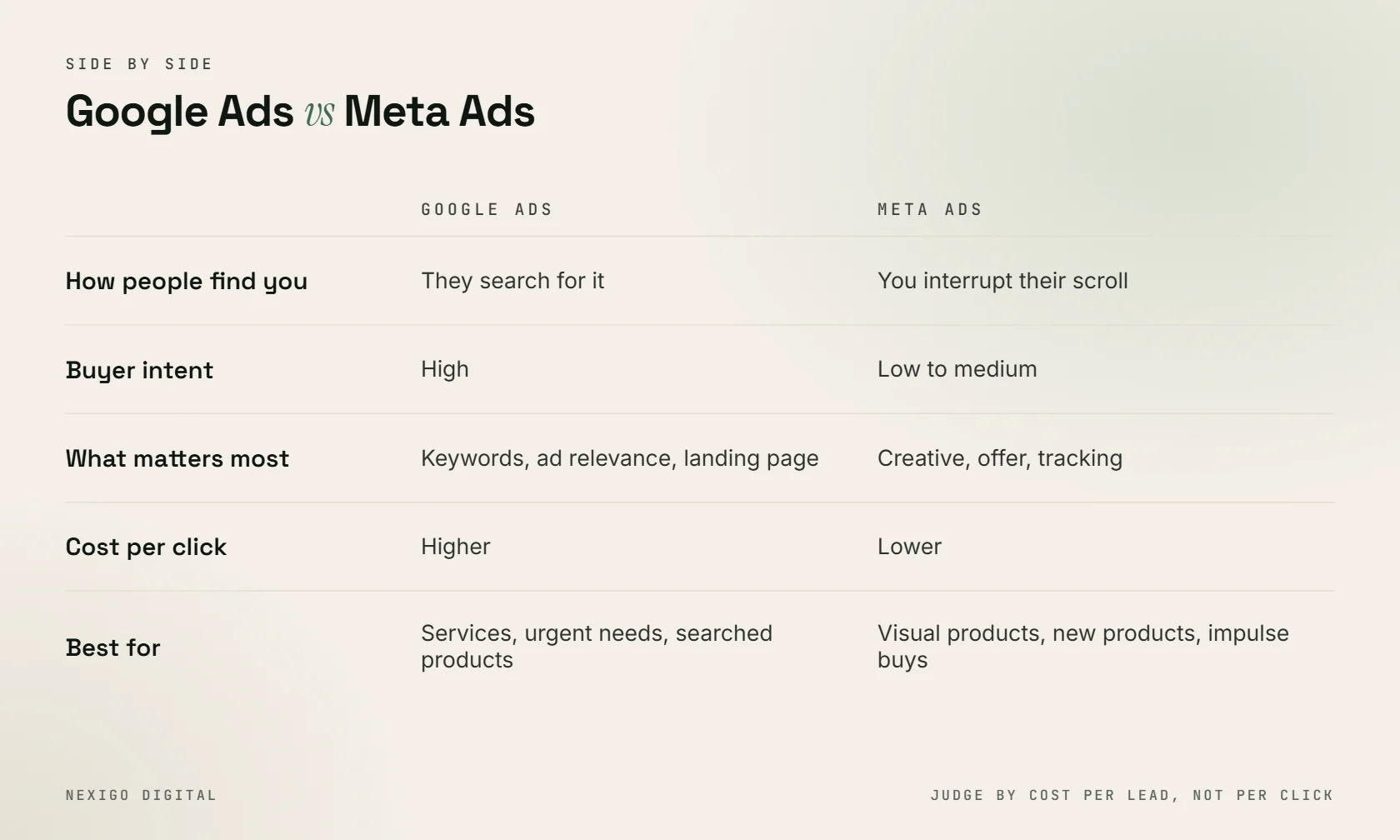
| Google Ads | Meta Ads | |
|---|---|---|
| How people find you | They search for it | You interrupt their scroll |
| Buyer intent | High | Low to medium |
| Targeting | Keywords, location, audiences | Interests, behaviour, lookalikes, broad AI targeting |
| What matters most | Keywords, ad relevance, landing page | Creative, offer, tracking |
| Typical cost per click | Higher | Lower |
| Best for | Services, urgent needs, searched products | Visual products, new products, impulse buys |
| Speed to results | Fast once keywords are right | Needs creative testing and data |
Which should you start with?
Use this as a rough guide:
Start with Google Ads if:
- People already search for what you sell
- You’re a service business or B2B company
- You need leads quickly and can handle the enquiries
- Your product is a considered purchase people research first
Start with Meta Ads if:
- Your product is visual and easy to understand in a few seconds
- People don’t search for your category much yet
- You sell direct to consumers online
- You have, or can produce, good photos and short videos
Use both if:
- You’re an e-commerce brand past the early testing stage
- Your budget can properly fund two channels
- You want Meta to build awareness and Google to catch people when they search later
Two examples: a clinic and a skincare brand
A dental clinic. People search “dentist near me”, “root canal cost” and “teeth whitening in [city]” when they need treatment. That’s Google Search territory. The clinic starts with a small Search campaign targeting a few kilometres around the practice, sends clicks to a landing page with prices, reviews and a booking form, and tracks calls as conversions. Once bookings are steady, it adds a modest Meta campaign retargeting website visitors with a whitening offer.
A new skincare brand. Nobody is searching for a brand they’ve never heard of. The brand starts on Meta with short videos showing the product in use, a clear offer and Advantage+ shopping campaigns, with Conversions API connected to the store. Once people start searching for the brand name, it adds Google brand search and Shopping campaigns to catch them.
Same advice in both cases: start where the buyer already is, then add the second channel when the first one is working.
How to split budget when you run both
There’s no perfect formula, but this is a sensible starting point:
- Start with one channel. Put 80–100% of your initial budget into the channel that best fits your business from the list above. Running two underfunded campaigns is the most common way to waste money.
- Prove it works. Get tracking right, find a cost per lead or sale you can live with, and keep it stable for four to six weeks.
- Add the second channel at 20–30%. For many D2C brands that’s Google Shopping or brand search alongside Meta. For many service businesses it’s Meta retargeting alongside Google Search.
- Shift budget based on blended results. Look at total cost per customer across both channels, not each platform’s own reported numbers. Both platforms tend to give themselves credit for the same sale.
Common mistakes to avoid
- No conversion tracking. If you can’t see which ads produce leads or sales, you’re guessing. Set up GA4, Google Ads conversion tracking and Meta CAPI before spending seriously.
- Sending ads to the homepage. Ads should land on a page built for that offer, with one clear action.
- Broad match keywords with no negatives on Google. This is how people end up paying for “free” and “jobs” searches.
- Boosting posts instead of running proper campaigns on Meta. Boosts are fine for engagement, not for sales.
- Judging results after three days. Both platforms need time and data. Give a campaign at least two to three weeks unless it’s clearly broken.
- Same creative for months on Meta. Ad fatigue is real.
Our take
If people search for what you sell, Google Ads usually pays back faster. If they don’t, or your product sells on looks and emotion, Meta Ads usually wins. Most growing businesses end up using both, with each one doing the job it’s good at.
The platform matters less than the basics: tracking, a good landing page, a clear offer and steady testing. Get those right and either platform can work.
If you’d like help setting this up, our team runs both Meta Ads management and Google Search PPC campaigns, with tracking set up properly from day one. Book a free call and we’ll tell you honestly which channel we’d start with for your business.
Frequently asked questions
Which is better, Facebook ads or Google ads?
Neither is better overall. Google Ads works best when people already search for what you sell, because it captures existing demand. Meta (Facebook and Instagram) Ads works best for visual or new products, because it creates demand among people who weren’t searching.
Are Meta Ads cheaper than Google Ads?
Meta usually has a lower cost per click, but Google clicks often convert at a higher rate because the person is already searching. Compare cost per lead or cost per sale, not cost per click.
How much should a small business spend on ads in India?
It depends on your industry and goals, but your budget should be enough to generate meaningful data. Start with one channel, run it for four to six weeks with proper tracking, and scale once you find a profitable cost per customer.
Should I run Meta Ads and Google Ads at the same time?
Once one channel is working, yes. Many businesses use Meta to build awareness and retarget visitors, and Google to capture people when they search. Start with one channel first, so you don’t split a small budget too thin.
What is the Meta Conversions API?
The Conversions API (CAPI) sends conversion events, like purchases and leads, from your server or store platform directly to Meta. It improves tracking accuracy when browser-based tracking is blocked, which helps Meta optimise your campaigns.
Need help with this?
Get a website that brings enquiries, not just visitors.
Send me your current website or idea on WhatsApp. I'll reply personally with honest advice and a clear quote.

Written by
Sourabh Kumar Pandit
I have been building websites and running SEO and ad campaigns for Indian businesses since 2019, with 200+ projects for 180+ clients from Delhi and Patna. I write these guides from what actually works on real client projects.